

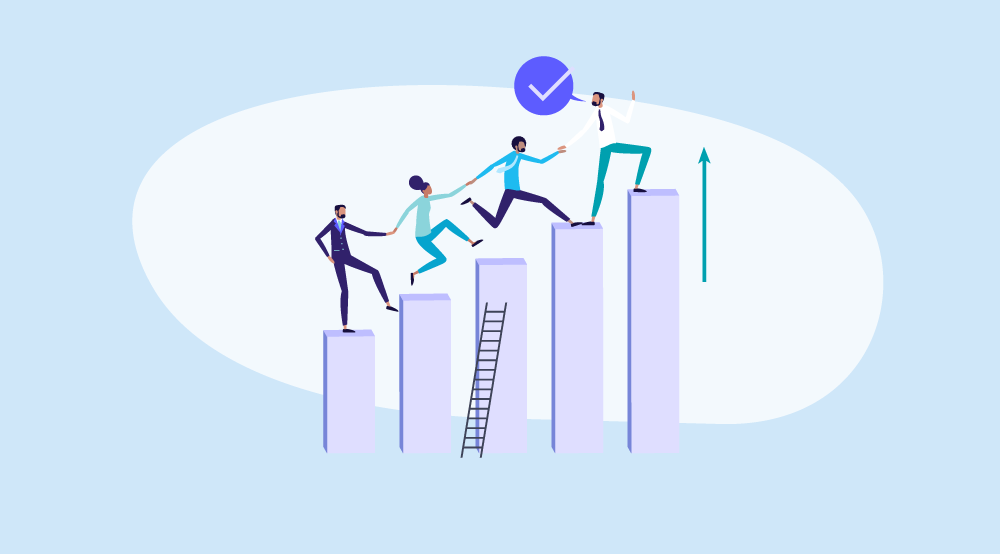
Developing strong coaching models and styles to use in the workplace is essential for fostering a collaborative, successful atmosphere. Good coaching by managers can enhance skills, boost morale, increase motivation, and ultimately lead to better productivity.
In a survey by HR.com and Together, 66% of HR professionals agree that coaching leads to increased individual performance, while 57% said it improves organizational performance.
Through coaching, employees become self-aware of their strengths and shortcomings and can take a proactive approach to addressing them with the help of a company-sponsored coach. Employees taking ownership of their performance and development enhances their productivity and work commitment, ultimately benefiting the organization.
This article explains what coaching is, compares key coaching models and styles, and shows how to choose the right approach when implementing coaching across the organization.
Contents
What are coaching models?
Types of coaching models
5 coaching models for the workplace
How to choose the right coaching model
6 styles of coaching in the workplace
Key takeaways
- Coaching models give managers, HR professionals, and coaches a structured way to guide employee development conversations.
- Different types of coaching models support different workplace needs, including leadership development, executive effectiveness, team collaboration, and sales performance.
- GROW, OSKAR, CLEAR, FUEL, and peer coaching can help employees set goals, reflect on challenges, explore options, and agree on next steps.
- Coaching styles describe how the coach approaches the conversation, from directive and facilitative to collaborative or situational.
- HR can strengthen coaching across the organization by training managers, providing coaching resources, and tracking progress through feedback and performance outcomes.
What are coaching models?
Coaching models are structured frameworks that guide coaching conversations in the workplace. They help managers, HR professionals, and coaches support employees as they set goals, reflect on challenges, explore options, and agree on next steps.
Workplace coaching is a collaborative relationship between a coach and an employee. The employee works toward specific, measurable goals that support their role, career aspirations, and the organization’s objectives, while the coach provides guidance, feedback, and support.
According to Gallup, coaching is an essential part of the employee experience. Employees tend to develop best when they receive coaching while working, including support with goal setting and meaningful feedback.
HR can support workplace coaching by guiding employees directly, designing structured programs, training managers in key coaching skills, providing templates and tools, and using program data to evaluate effectiveness.

Coaching models vs. coaching styles vs. coaching methods
A coaching model gives the conversation structure, a coaching style describes how the coach approaches the conversation, and coaching methods are the techniques used during the session.
Coaching model
The framework that guides the conversation
GROW, OSKAR, CLEAR, FUEL
Coaching style
The coach’s approach or behavior
Directive, facilitative, democratic
Coaching method
The technique used during coaching
Active listening, feedback, goal setting
Types of coaching models
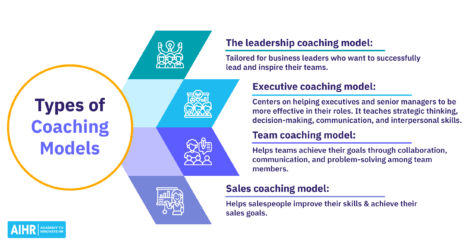
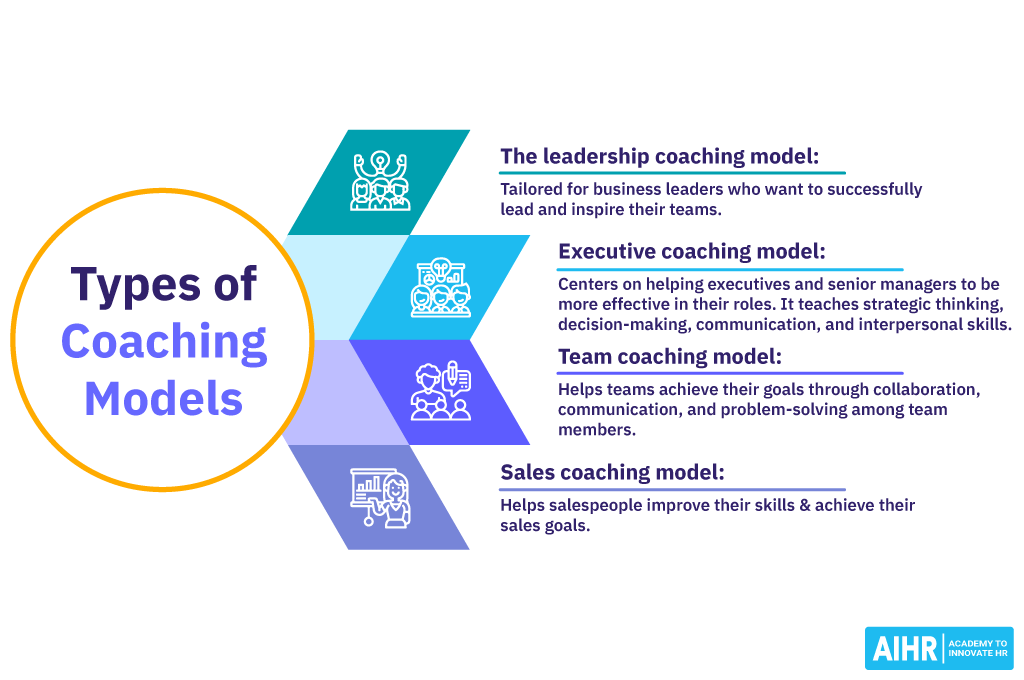
Different types of coaching models support different workplace needs. Some are designed to develop leaders, while others help executives improve decision-making, teams collaborate more effectively, or employees strengthen role-specific skills.
- Leadership coaching: Helps current and future leaders build the skills they need to guide, motivate, and support their teams. It can focus on areas like setting team goals, delegating tasks, resolving conflicts, giving feedback, and improving communication.
- Executive coaching: Supports executives and senior managers in becoming more effective in their roles. It often focuses on strategic thinking, decision-making, stakeholder management, communication, executive presence, and interpersonal skills.
- Team coaching: Strengthens how teams work together to achieve shared goals. Team members identify their objectives, discuss challenges, improve communication, and develop strategies for collaboration and problem-solving.
- Sales coaching: Guides sales professionals in improving their skills and achieving their sales goals. It can cover areas like sales planning, pipeline management, customer conversations, performance assessment, and optimization.
5 coaching models for the workplace
The best coaching models give conversations structure and help employees clarify goals, explore options, and agree on practical next steps. Here are five coaching framework examples:
1. GROW coaching model
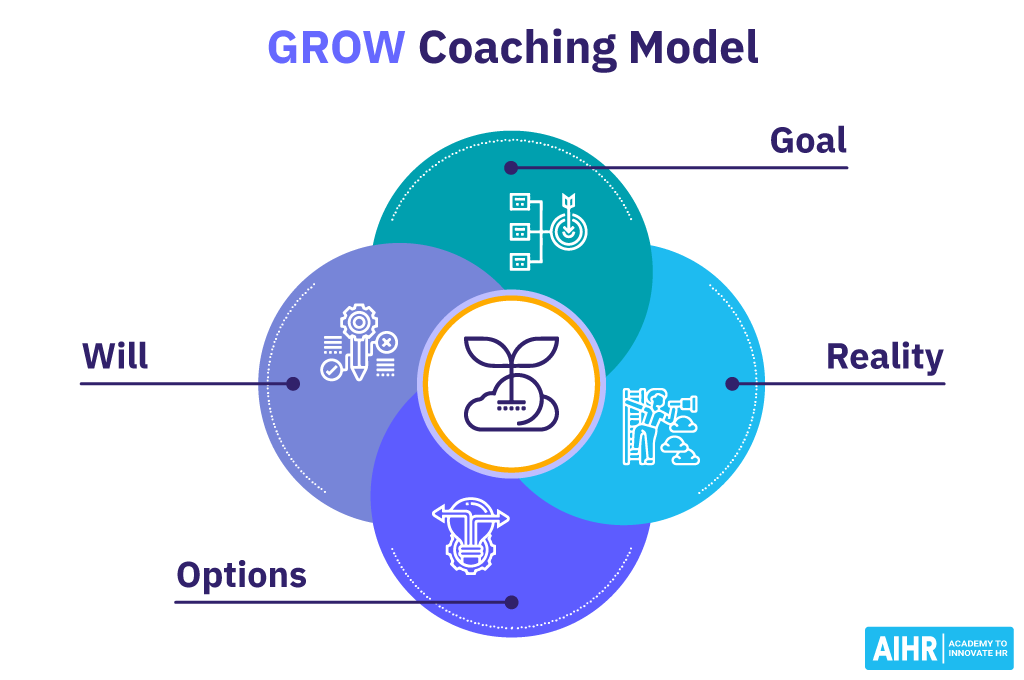
The GROW coaching framework is a simple process well-suited for setting and achieving goals. It is ideal for new coaches and coachees with short-term goals or specific challenges.
GROW stands for Goals, Reality, Options, and Will
- Goals: The coach helps the coachee determine their goals by setting SMART goals (specific, measurable, achievable, relevant, and time-bound).
- Reality: Coach asks questions to identify the coachee’s weaknesses and challenges.
- Options: The coach and coachee brainstorm different options and strategies to close the gap between goals and reality.
- Will: The coach helps the coachee draw an action plan for achieving their goals, including identifying specific steps, assigning responsibilities, and setting deadlines.
Example
- Goal: A marketing manager needs help to meet her sales target. She wants to raise her sales performance by 10% and increase her team’s productivity.
- Current reality: The marketing manager’s sales figures have plummeted over the past few months, averaging 15% less than the sales quota. She is feeling stressed with the performance. Moreover, her team members are not fully engaged in their work.
- Options: The marketing manager has the following options to improve the sales targets:
- Develop and implement multiple marketing strategies
- Delegate admin tasks to her team members so she can focus on more strategic ones
- Train her team members and be more supportive
- Implement a new incentive program to reward the best-performing members.
- Will: The marketing manager formulated a comprehensive marketing plan to grow her sales targets:
- Use paid ads and social media to boost marketing efforts
- Assign tasks to team members, like appointment setting and answering after-sales queries, so the manager can focus more on important tasks like reviewing sales performance, meeting high-value clients, and leads
- Conduct training on different sales techniques and customer relationship management
- Give cash incentives to sales staff who exceed their sales targets.
- The marketing manager and the coach meet regularly to track progress and make adjustments as needed.
HR tip
Use coaching during performance reviews, one-on-one meetings, and career development conversations to help employees set clear development goals. This gives managers a more structured way to discuss progress, identify skill gaps, and agree on practical next steps.
2. OSKAR coaching model
The OSKAR model is a solution-focused coaching methodology that aims to address complex problems and accomplish long-term goals. This model is beneficial for coachees who are feeling overwhelmed or stuck.
OSKAR stands for Outcome, Scale, Know-how, Affirmation, Action and Review
- Outcome: The coach helps the coachee define the desired result by setting SMART goals. SMART goals provide clear direction and remove distractions.
- Scaling: The coach and coachee evaluate the scale of the goal, considering its feasibility and potential impact to make sure it is realistic and aligned with the coachee’s bigger plans.
- Know-how and resources: The coach and coachee then determine the skills and resources needed to reach the goal, which includes mentoring, training, or access to specific tools or equipment.
- Affirm and action: The coach assists the coachee to affirm their strengths and beliefs. They create an action plan, which outlines the steps and the deadlines.
- Review: The coach and coachee regularly review progress, identify other obstacles, and adjust the action plan as required. This guarantees that the coachee stays on track and progresses toward the goal.
Example
An employee is often absent from work. He consistently arrives late or leaves early. His behavior causes project delays and affects the whole team.
- Outcome: The coach and the employee discuss the desired outcome: the employee will comply 100% with the company’s attendance policy and be a team player. The employee must not be absent more than twice every quarter. He must also not be late or leave early at work.
- Scaling: On a scale of 1 to 10, the coach asks the employee to rate his current attendance. The employee is aware of his numerous absences and rated himself at 5. He is late or absent due to a bad habit of procrastination.
- Know-how and resources: The coach and the employee explore solutions to address the underlying causes of procrastination, focusing on time and stress management strategies. Additionally, the coach recommended employee assistance programs, wellness benefits, and flexible work schedules.
- Affirm and action: The coach acknowledges the employees’ honesty and commitment to address their problems. Together, they develop a concrete plan with specific steps, like:
- Implementing time management tools and techniques, such as creating a work schedule and sticking to it
- Discussing the possibility of remote work or a flexible work schedule to avoid being late or absent
- Establishing a clear communication protocol that requires the employee to immediately notify their supervisor in case of absence
In addition, the coach stressed that the employee is 100% responsible for his attendance and encourages him to prioritize his wellbeing and work commitment.
- Review: The coach and employee schedule regular check-ins to review attendance, discuss what is working, and address any new obstacles. They use these sessions to adjust the action plan when needed, reinforce progress, and keep the employee accountable for meeting the agreed attendance expectations.
Coaching models give managers and HR professionals a clear structure for employee development conversations. Building this skill helps you support behavioral change, guide better performance conversations, and make coaching a stronger part of your L&D strategy.
AIHR’s Learning & Development Certificate Program gives you the tools to:
✅ Apply coaching models, including GROW, in workplace conversations
✅ Implement coaching to support behavioral change
✅ Identify skills gaps and choose targeted learning interventions
✅ Use learning analytics to measure the impact of L&D initiatives
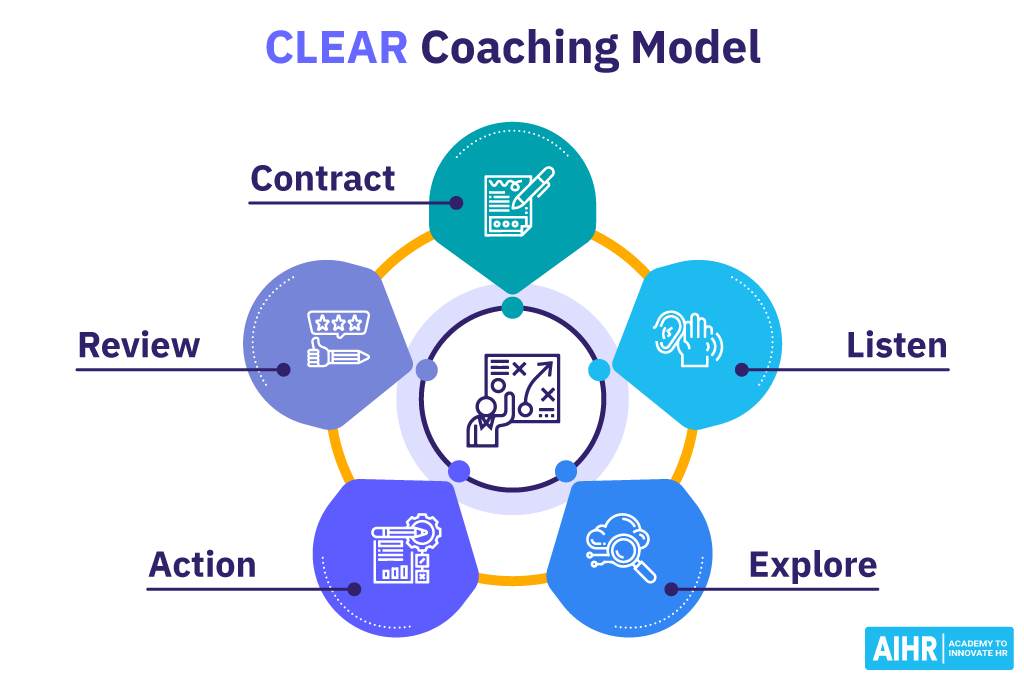
3. CLEAR coaching model
The CLEAR Model is a process-oriented coaching method that promotes building rapport and trust between the coach and the coachee. It is a good choice for coaches working with coachees who are new to coaching or hesitant to open up about their challenges. Organizations should build close professional relationships among employees and create a coaching culture.
CLEAR stands for Contract, Listen, Explore, Action and Review
- Contract: The coach and coachee list down the goals, expectations, and limitations of the coaching process
- Listening: The coach uses open-ended questions to understand the coachee’s concerns, perspectives, challenges, and aspirations.
- Exploring: The coach encourages the coachee to reflect and explore underlying beliefs and patterns influencing their behavior.
- Action: The coach and coachee collaboratively develop a plan of action, outlining SMART goals, actionable steps, and necessary resources to achieve the desired outcomes
- Review: The coach and coachee meet regularly to evaluate the progress. The coach provides feedback, celebrates achievements, and adjusts the action plan when necessary.
Example
A software engineer needs help meeting deadlines and passing his manager’s quality checks. He feels overwhelmed and stressed, and his performance has declined recently.
- Contracting: The coach and engineer discuss the purpose of their coaching agreement. The engineer expressed unhappiness with his performance and his desire to improve. The coach then outlined the coaching process and explained it would be teamwork in identifying solutions and achieving goals.
- Listening: The coach asks open-ended questions to fully understand the engineer’s challenges and frustrations about his inability to send work on time and have high-quality output. The coach actively listens without interrupting or judging the engineer, providing a supportive environment that allows the engineer to be transparent with his concerns.
- Exploring: The coach encourages the engineer to examine the factors causing poor performance. The engineer identifies his problems: difficulty managing his time, prioritizing tasks, and understanding the manager’s expectations. He also acknowledges his tendency to delay decision-making whenever he feels overwhelmed with complex projects.
- Action: With the coach’s guidance, the engineer developed an action plan to address his performance issues. The plan includes:
- Clearly assign tasks to team members and set deadlines to create accountability
- Submit daily progress reports to monitor work and flag problems early
- Provide the necessary tools and resources to help team members work more efficiently and avoid delays.
- Review: The coach, manager, and engineer regularly review progress, monitor goals, and adjust action plans as needed.
4. FUEL coaching model
The FUEL model aims to change behavior or improve performance. It emphasizes understanding the coachee’s motivation, challenges, and opportunities and creating a plan with actionable steps to achieve goals.
FUEL stands for Frame the Conversation, Understand the Current State, Explore the Desired Goal, and Lay Out the Plan
- Frame the conversation: The coach and coachee agree on the purpose of the coaching relationship, the process, and the result.
- Understand the current state: Next, the coach asks open-ended questions to discover the coachee’s present situation and their values, strengths, and available resources. During this discovery phase, the coach also tries to identify any weaknesses and obstacles that are getting in the way of the coachee achieving their goals.
- Explore the desired goal: Envisioning their desired future state, the coach helps the coachee set SMART goals. Together, they explore options and methods for achieving the targeted outcome.
- Lay out the plan: Once the coachee decides on options and goals, they draw an action plan listing specific steps and timelines. KPIs are created to track progress. The coach regularly checks with the coachee for feedback and support.
Example
The new project manager has difficulty managing a complex project with multiple stakeholders’ approval, conflicting deadlines, and limited resources. He feels stressed and uncertain of his ability to complete the project.
- Frame the conversation: The coach and coachee establish the coachee’s goals, defining the roles and responsibilities of each person.
- Understand the current state: Next, the coach asks open-ended questions regarding the project manager’s challenges: problems delegating tasks, communicating with team members, and managing stakeholders’ expectations. The project manager acknowledged he didn’t have enough experience for the project and was anxious about his ability to complete it on time and satisfy stakeholders’ expectations.
- Explore the desired goal: The coach encouraged the project manager to envision the desired outcome: getting the stakeholders’ approval, confidently leading, and completing the project. They discussed various steps to help accomplish the objective:
- Implement project management tools like Agile or Kanban
- Communicate effectively with members through progress reports and regular meetings
- Delegate tasks effectively so everyone contributes equally to project completion and avoids missing deadlines
- Regularly update stakeholders to manage their expectations and avoid misunderstandings.
- The coach guides the project manager to create SMART goals to complete the project and communicate frequently.
- Lay out the plan: The coach and project manager collaborated to develop a concrete action plan outlining the steps, timeline, and required resources. They also set KPIs to monitor and measure progress, such as budget adherence, stakeholder satisfaction, and meeting deadlines. Finally, they agreed to have weekly check-ins and coaching sessions.
5. Peer coaching model
Peer coaching is a collaborative process where individuals work together to reflect on their practices, set goals, and provide each other with feedback and support. In this model, peers take turns acting as coach and coachee, helping each other learn from real workplace situations.
Integrating peer coaching into the workplace by HR can contribute significantly to employee development, teamwork, and overall organizational success. HR can support this process by training employees in effective coaching techniques, active listening, constructive feedback, and confidentiality.
Example
Two newly promoted team leads are struggling with different leadership challenges. One finds it difficult to delegate tasks, while the other is unsure how to give constructive feedback to a team member whose performance has declined.
Through peer coaching, they meet every two weeks to discuss their challenges, ask each other open-ended questions, share advice, and agree on one action to take before the next session. One decides to delegate a recurring task with clearer expectations and a deadline. The other prepares a feedback conversation using specific examples and a clear improvement goal.
At their next session, they review what worked, what they would do differently, and how they can apply the lessons in future leadership situations.
HR tip
Provide access to coaching resources, such as internal coaches, external coaching partners, templates, or online coaching platforms. This makes coaching more accessible and helps build a stronger coaching culture.
How to choose the right coaching model
The right coaching model depends on the employee’s goal, the type of conversation, and the support they need. You can use the table below to choose the most suitable model for common workplace coaching situations:
An employee needs to set or achieve a specific goal
GROW coaching model
It gives the conversation a clear structure, from defining the goal to agreeing on next steps.
An employee feels stuck or overwhelmed
OSKAR coaching model
It focuses on strengths, available resources, and practical actions instead of only the problem.
An employee is new to coaching or hesitant to open up
CLEAR coaching model
It emphasizes trust, active listening, and reflection before moving into action.
A manager needs to address performance or behavior
FUEL coaching model
It helps frame the conversation, understand the current situation, and create a focused action plan.
Employees can learn from each other’s experience
Peer coaching model
It encourages knowledge sharing, feedback, accountability, and shared learning.
HR teams can also help managers choose a coaching model by providing simple decision guides, conversation templates, and training on when to use each approach.
6 styles of coaching in the workplace
Apart from different coaching models, there are also different coaching styles. A coaching model gives the conversation structure, while a coaching style describes how the coach approaches the conversation with the employee.
1. Directive coaching
In directive coaching, the coach takes a more active role by providing specific guidance, recommendations, or instructions. The coach leads the conversation and helps the employee determine the next action.
Provides clear guidance and quick decision-making
May discourage independent thinking
Effective for urgent or critical situations
Might create dependence on the coach
Suitable for individuals with limited experience
Limits the coachee’s ability to develop problem-solving skills
When to use
Use directive coaching when the employee needs clear guidance, lacks experience, or must act quickly in a specific situation.
2. Nondirective or facilitative coaching
Nondirective coaching, also known as facilitative coaching, emphasizes open-ended questions, active listening, and self-discovery. Instead of giving direct answers, the coach helps the employee explore their own thoughts, ideas, and solutions.
Encourages self-discovery and independent problem-solving
Requires more time for coachee reflection and exploration
Fosters critical thinking and creativity
May not be suitable for urgent situations
Builds the coachee’s confidence and autonomy
Effectiveness depends on the coachee’s readiness for self-directed learning
When to use
Use nondirective coaching when the employee needs to build problem-solving skills, gain insight, or take more ownership of their development.
3. Autocratic coaching
In autocratic coaching, the coach makes decisions with limited input from the employee. The coach provides clear instructions, sets expectations, and expects the employee to follow the agreed direction.
Enables quick decision-making
May lead to a lack of coachee engagement
Effective in situations where the coach has specific expertise
Could result in reduced motivation and initiative
Provides a clear direction for the coachee
Limits input and creativity from the coachee
When to use
Autocratic coaching may be appropriate in situations where quick decisions are needed, when the situation requires expert guidance, or when there is little room for trial and error.
4. Democratic or collaborative coaching
Democratic coaching involves shared decision-making between the coach and employee. The coach asks for input, considers the employee’s perspective, and works with them to decide on the best next steps.
Encourages teamwork and collaboration
Decision-making process may be time-consuming
Fosters a sense of ownership and commitment
Requires effective communication and conflict resolution skills
Considers diverse perspectives and ideas
Coachee input may not always align with organizational goals
When to use
Democratic coaching is suitable when the employee’s input is valuable, when building commitment is important, or when the goal requires collaboration and shared ownership.
5. Laissez-faire coaching
Laissez-faire coaching is a hands-off style where the coach provides minimal guidance and gives the employee space to lead their own development. The coach remains available for support, but the employee takes primary responsibility for progress.
Empowers highly self-directed and motivated coachees
May lead to a lack of structure or direction
Allows for independent decision-making and initiative
Could result in disengagement or lack of progress
Fosters a sense of responsibility and accountability
May not be suitable for individuals who require more guidance
When to use
Laissez-faire coaching can be appropriate when the coachee is highly self-directed, experienced, and capable of managing their own development with minimal oversight.
6. Situational coaching
Situational coaching involves adapting the coaching style based on the specific circumstances and needs of the coachee. The coach assesses the situation and adjusts their approach accordingly.
Adaptable to the specific needs of the coachee
Requires strong judgment from the coach
Tailors coaching approach to different situations
Can feel inconsistent if expectations are unclear
Enhances flexibility and responsiveness
Requires the coach to read the situation accurately
When to use
Use situational coaching when employees have different levels of experience, confidence, or readiness, or when the coaching conversation changes from one stage to the next.
Key takeaway
Different coaching models and styles support different employee needs, goals, and workplace situations. When choosing the right approach, HR should consider the employee’s development needs, the organization’s objectives, the coach’s experience, and the context of the coaching conversation.
HR should also choose flexible models of coaching that managers can adapt to different business needs. Gathering feedback, tracking progress, and monitoring employee improvement can help evaluate whether coaching is driving meaningful development and performance outcomes.
To build stronger coaching and development programs, HR professionals need the right L&D skills. AIHR’s Learning & Development Certificate Program helps you design learning strategies, identify skills gaps, implement coaching effectively, and use learning analytics to measure whether development initiatives are driving meaningful behavior change and business impact.