



When an employee leaves, HR has one final opportunity to understand what worked, what didn’t, and what could have kept them from leaving. Asking the right exit interview questions helps organizations uncover patterns in employee turnover, including manager support and workload, compensation, career growth, culture, and the overall employee experience.
This article includes common exit interview questions HR teams can use to guide more meaningful conversations with departing employees. You’ll also find tips on how to conduct exit interviews effectively, questions for specific situations, and a downloadable exit interview questions template to help you collect feedback consistently.
Contents
What is an exit interview?
Why are exit interviews important?
Best exit interview questions to ask employees
Exit interview questions for specific situations
Final questions to ask in an exit interview
Free exit interview questions template (PDF)
How to conduct exit interviews effectively
FAQ
Key takeaways
- Exit interviews help HR understand why employees leave and what the organization can improve across management, workload, culture, compensation, and career growth.
- Use a consistent set of core exit interview questions so you can compare feedback across employees, teams, departments, and locations.
- Adapt your questions to the employee’s situation, such as their role, reason for leaving, or relationship with the organization.
- The value of exit interviews comes from action. Track recurring themes, share insights with leaders, and use the feedback to improve retention.
What is an exit interview?
An exit interview is a structured conversation with an employee before they leave the organization. HR uses it to understand the employee’s reasons for leaving, their experience in the role, and any feedback that could help improve the workplace.
Exit interviews are usually part of the employee offboarding process and can be conducted in person, virtually, or via a written survey. They are often led by HR or another neutral representative, rather than the employee’s direct manager, so the departing employee feels more comfortable sharing honest feedback.
For the feedback to be useful, HR should ask consistent exit interview questions, document key themes, and look for patterns across teams, departments, or employee groups. This helps turn individual feedback into insights the organization can act on.

Why are exit interviews important?
Exit interviews help HR understand why employees leave and what the organization can improve. By asking the right questions, employers can gather honest feedback on the employee experience, including the role, manager relationship, workload, career growth, compensation, culture, and work environment.
The value for HR comes from identifying patterns across multiple exit interviews. For example, recurring feedback about unclear job expectations may point to gaps in recruitment or onboarding, while repeated comments about limited growth opportunities may signal retention risks. HR can use these insights to improve workplace policies, strengthen management practices, and create a better experience for current and future employees.
Conducting exit interviews also gives departing employees a chance to share their perspective and leave on a more positive note.
Best exit interview questions to ask employees
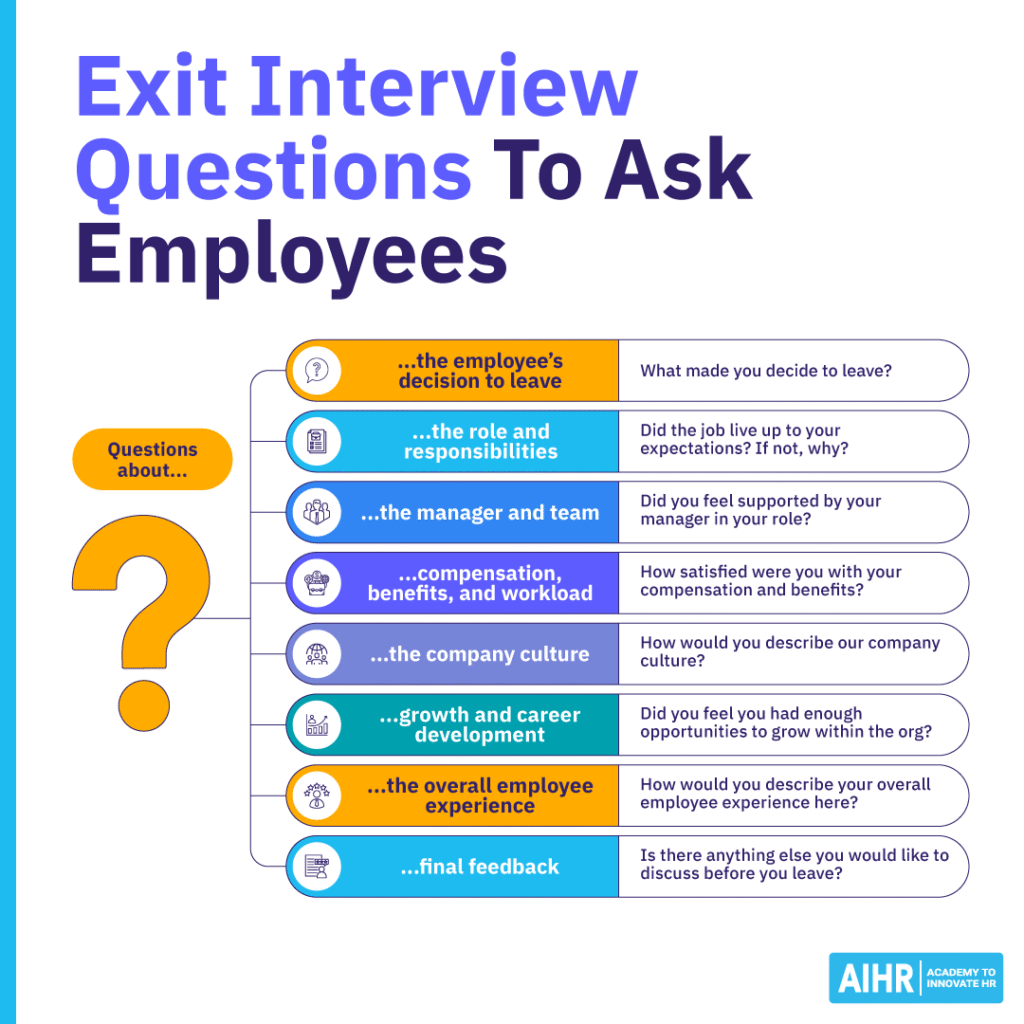
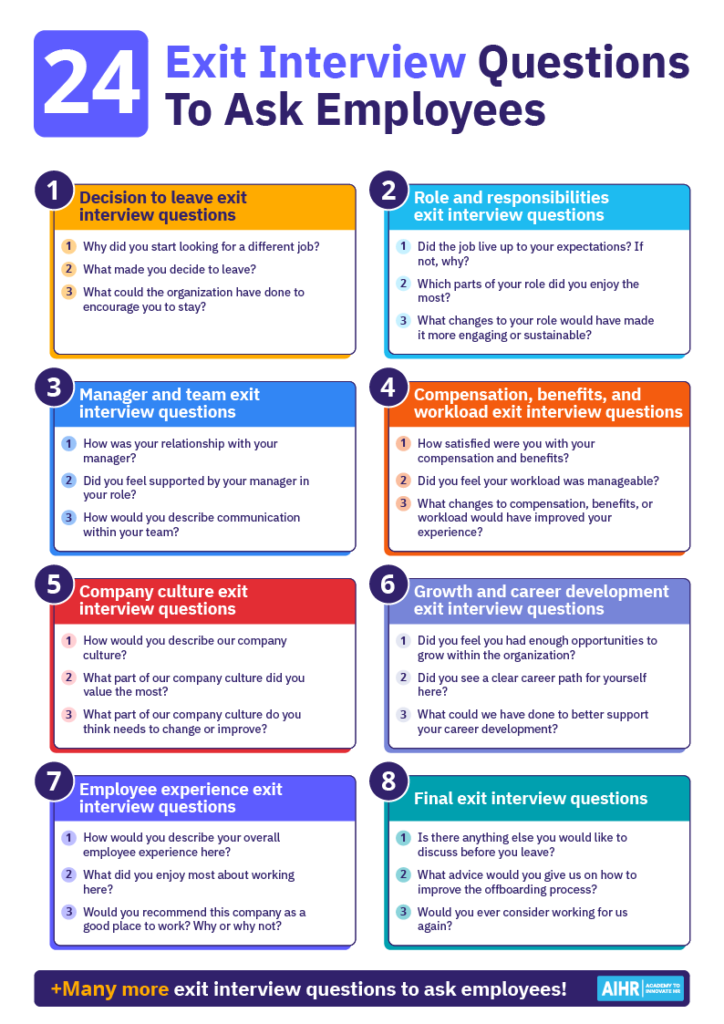
Good exit interview questions help HR understand why employees leave, what their experience was like, and what the organization can improve. Use the categories below to choose the questions most relevant to the employee’s role, reason for leaving, and work environment.
You can jump to the various sections covering the employee exit interview questions to ask below:
- The employee’s decision to leave
- The role and responsibilities
- The manager and team
- Compensation, benefits, and workload
- Company culture
- Growth and career development
- Employee experience
Keep in mind, you don’t need to ask every question in one interview. Pick the ones that best match the employee’s situation, and use a consistent set of core questions across interviews so you can compare feedback and identify recurring themes.
Exit interview questions about the employee’s decision to leave
1. Why did you start looking for a different job?
The answers you get to this question will vary. Some employees start looking because they want a new professional challenge, better compensation, more flexibility, a shorter commute, or to relocate for personal reasons.
Over time, however, you may start to see common themes in the answers. These patterns can help HR understand what pushes employees to explore other opportunities and what the organization can improve to retain talent.
“There’s always a moment, the last proverbial straw, that pushes an employee to be open to new opportunities. That moment is key in identifying the gap that you can close to increase your retention,” points out Kate Conroy, a senior consultant at Red Clover HR.
2. What made you decide to leave?
This question may feel similar to the previous one, but it focuses on the final reason behind the employee’s decision. The reason someone starts looking for another job is not always the same as the reason they ultimately leave.
For example, an employee may begin looking because they feel ready for a new challenge, but decide to leave because another company offers stronger career growth, better benefits, or a more flexible work arrangement.
This distinction helps HR separate early signs of disengagement from the final deciding factors that lead employees to resign.
3. Was there a specific moment, event, or change that influenced your decision to leave?
Employees do not always leave because of one single issue, but there is often a turning point that makes them more open to other opportunities. This could be a leadership change, team restructures, missed promotion, increase in workload, conflict, or change in work arrangements.
Asking this question helps HR understand whether the employee’s decision was gradual or triggered by a specific experience. If similar moments come up across multiple exit interviews, they may point to retention risks that need closer attention.
4. Did you discuss your concerns with anyone before deciding to leave?
The answer can show whether employees feel comfortable raising concerns before they resign. If they did speak up, ask whether their concerns were acknowledged, followed up on, or resolved.
If departing employees often say they did not raise their concerns, this may point to issues with psychological safety, manager check-ins, feedback channels, or trust in the organization’s ability to act on feedback.
5. What could the organization have done to encourage you to stay?
This question helps identify whether there were realistic actions the organization could have taken to retain the employee. Their answer may point to career development, compensation, workload, flexibility, manager support, recognition, or changes to the role.
Some reasons for leaving may be outside the organization’s control. However, recurring answers can help HR identify practical opportunities to improve retention and address issues before more employees leave.
6. Would you ever consider working for us again?
Not every employee leaves because they had a negative experience. Some employees leave because the timing, role, location, compensation, or growth opportunities no longer fit their needs.
This question can help HR understand whether the employee would consider returning in the future. You can also ask a follow-up question, such as: “What would need to change for you to consider coming back?” Their answer can reveal how the organization is perceived by departing employees and whether they could become future boomerang employees.
Exit interviews help HR uncover why employees leave and turn feedback into practical improvements across the employee lifecycle.
With the HR Generalist Certificate Program, you’ll learn to:
✅ Manage HR processes from onboarding to offboarding
✅ Navigate sensitive employee conversations professionally
✅ Identify feedback patterns around engagement, rewards, and retention
✅ Use practical templates to improve HR consistency
🎓 Build the HR Generalist skills to turn employee feedback into better experiences and stronger HR operations.
Exit interview questions about the role and responsibilities
7. Did the job live up to your expectations? If not, why?
This question is especially useful if your organization is experiencing high new hire turnover. It can help HR understand whether there is a gap between how the role was presented during recruitment and what the employee experienced once they joined.
If the answer is no, dig deeper. Was the job ad unclear? Did the interview process overstate certain parts of the role? Were the responsibilities different from what the hiring manager described? Sharing this feedback with the recruitment team can help create more accurate job descriptions and set clearer expectations for future candidates.
8. Did your responsibilities change since you were hired? If so, how?
Roles often evolve, but major changes can create frustration if they are not communicated clearly or reflected in the job description. Their response can show whether the role changed in ways that affected their engagement, performance, or decision to leave.
The answer can also highlight where job descriptions need updating. If several employees mention that their actual responsibilities differ from what they were hired to do, HR and hiring managers can use that feedback to improve role design and recruitment messaging.
9. Which parts of your role did you enjoy the most?
Every employee will enjoy different aspects of their work, but recurring answers can help HR understand what makes a role attractive. For example, employees may value autonomy, problem-solving, collaboration, client interaction, or opportunities to work on strategic projects.
This feedback can also support recruitment and employer branding. If departing employees consistently mention the same positive aspects of a role, those points can be emphasized in future job ads and candidate conversations.
10. Which parts of the role did you enjoy the least?
This question helps HR identify recurring pain points in the role. Employees may mention repetitive tasks, unclear priorities, administrative burden, lack of autonomy, limited resources, or responsibilities that do not match their skills.
Over time, these answers can help the organization improve job design. They can also help hiring teams give candidates a more realistic picture of the role, thereby reducing expectation gaps and early turnover.
11. What skills or qualities should we look for in your replacement?
The departing employee has firsthand experience with what the role actually requires. Their answer can help HR and hiring managers understand which skills, traits, or experiences matter most in the position today.
This is especially helpful if the role has changed since the employee was hired. Their feedback can help update the job description, refine candidate criteria, and improve the accuracy of the recruitment process.
12. What changes to your role would have made it more engaging or sustainable?
This question focuses on the role itself rather than the employee’s broader reason for leaving. It can reveal whether they needed more variety, clearer responsibilities, better tools, more autonomy, different projects, or a workload that felt more realistic.
If several employees in similar roles give the same answer, HR may need to review the role’s design. For example, repeated feedback about repetitive tasks may point to opportunities for automation, job enrichment, or clearer career progression.
Exit interview questions about the manager and team
13. How was your relationship with your manager?
There is a common saying that employees don’t leave their job, they leave their manager. While that isn’t always the case, the manager-employee relationship can have a significant impact on someone’s experience at work.
To encourage honest feedback, it’s usually best for someone other than the employee’s direct manager to conduct the exit interview. If several employees mention similar concerns about the same manager, HR can look into the issue more closely. Positive feedback can also help identify strong leadership practices that other managers can learn from.
14. Did you feel supported by your manager in your role?
Support can mean different things to different employees. Some may need clearer priorities, more regular feedback, coaching, help removing roadblocks, or more autonomy.
Their answers can help HR understand whether managers are giving employees the guidance and resources they need to succeed. If a lack of support comes up often, it may point to gaps in manager training, communication, or day-to-day leadership.
15. How would you describe communication within your team?
Strong team communication helps employees understand priorities, collaborate effectively, and feel included in decisions that affect their work. Poor communication, on the other hand, can lead to confusion, duplicated work, frustration, or disengagement.
Pay attention to how employees describe meetings, updates, feedback, and day-to-day collaboration. Recurring comments about unclear communication may show where teams need better processes, clearer ownership, or more consistent manager updates.
16. Did you feel your contributions were recognized by your manager or team?
Recognition plays an important role in employee motivation and engagement. When employees feel their efforts go unnoticed, they may become less connected to their work or less likely to see a future with the organization.
Answers can reveal whether recognition is consistent, meaningful, and fairly distributed across the team. They may also highlight simple improvements, such as more regular feedback, clearer appreciation from managers, or stronger peer recognition.
17. Were there any team dynamics that affected your experience at work?
Team dynamics can shape an employee’s day-to-day experience just as much as the role itself. Collaboration, trust, workload sharing, conflict, and inclusion all influence whether employees feel supported and able to do their best work.
If employees mention recurring tension, lack of collaboration, or uneven expectations within the team, HR can use that feedback to identify where managers may need to address underlying issues.
Exit interview questions about compensation, benefits, and workload
18. How satisfied were you with your compensation and benefits?
Pay and benefits are not always the main reason employees leave, but they can strongly influence someone’s decision to explore other opportunities. This is especially true if employees feel their compensation does not reflect their responsibilities, experience, performance, or market value.
Compensation feedback can show whether pay and benefits concerns are isolated or part of a broader retention issue.
If similar feedback comes up across roles, teams, or departments, it may be worth reviewing salary bands, benefits packages, or how clearly compensation decisions are communicated.
19. Did you feel your workload was manageable?
An unmanageable workload can lead to stress, burnout, lower engagement, and eventually turnover. Employees may mention too many competing priorities, unclear expectations, understaffing, or not enough time to do high-quality work.
If workload concerns come up often, look at whether the issue is linked to a specific role, manager, team, or time of year. This can help HR and leadership identify whether the solution is better prioritization, clearer role design, more resources, or additional headcount.
20. Did your workload feel realistic for your role and responsibilities?
Workload can be a major factor in an employee’s decision to leave, especially when expectations, deadlines, or priorities feel unmanageable. Employees may mention understaffing, too many competing tasks, unclear ownership, or responsibilities that expanded beyond the original scope of the role.
Their answer can help HR understand whether workload issues are linked to the role itself, the team structure, manager expectations, or broader resourcing challenges.
If similar feedback comes up often, it may be worth reviewing how work is distributed and whether employees have the time, support, and resources to meet expectations sustainably.
21. Did you have the flexibility you needed to do your best work?
Flexibility can include work location, schedule, working hours, or the ability to manage personal responsibilities alongside work. For some employees, a lack of flexibility may be a major reason for leaving, especially if another employer offers a better arrangement.
It can also reveal whether flexible work policies are clear, consistent, and applied fairly across teams.
22. Were you satisfied with the resources and support available to manage your workload?
Employees may be willing to take on challenging work if they have the right support. Problems often arise when workload increases without the tools, staffing, guidance, or decision-making support needed to handle it well.
Answers may point to gaps in planning, resourcing, prioritization, or manager support.
If several employees mention the same blockers, HR can use that feedback to help leaders improve how work is distributed and supported.
23. What changes to compensation, benefits, or workload would have improved your experience?
This gives employees room to share practical suggestions rather than only describing what did not work. They may point to more competitive pay, better benefits, clearer bonus criteria, improved flexibility, more realistic deadlines, or a better balance between responsibilities and resources.
Exit interview questions about company culture
24. How would you describe our company culture?
Employees may experience company culture differently depending on their role, team, location, manager, or level of seniority. Asking this can help HR understand whether the culture people experience day to day matches the culture the organization wants to build.
Pay attention to recurring words or themes. If employees consistently describe the culture as supportive, transparent, or collaborative, those strengths can support employer branding and engagement efforts.
If the same negative themes come up repeatedly, such as poor communication, lack of trust, or unhealthy competition, HR can use that feedback to identify where the culture needs closer attention.
25. What part of our company culture did you value the most?
This helps identify the cultural strengths employees genuinely appreciate. They may mention flexibility, collaboration, autonomy, transparency, inclusion, recognition, or the way teams support each other.
Recurring positive answers can show what the organization should preserve as it grows or changes. They can also help HR understand which parts of the culture are most meaningful to employees.
26. What part of our company culture do you think needs to change or improve?
No company culture is perfect, and departing employees may be more willing to share honest feedback about what was not working for them.
Their answers may point to issues like unclear decision-making, lack of accountability, poor communication, limited inclusion, inconsistent leadership behavior, or a mismatch between stated values and everyday actions. If similar feedback appears across multiple exit interviews, it can help HR prioritize meaningful culture improvements.
27. Were there any aspects of the company culture that contributed to your decision to leave?
This links culture feedback directly to the employee’s decision to leave. For example, an employee may have felt that the pace of work was unsustainable, that values were not reflected in leadership behavior, or that the environment did not support their preferred way of working.
Answers can also reveal whether the issue was company-wide or more specific to a team, department, or manager.
28. Did you feel included and respected at work?
Inclusion and respect are central to how employees experience workplace culture. Employees may share whether they felt heard in meetings, treated fairly, included in decisions, or comfortable being themselves at work.
If employees mention feeling excluded, overlooked, or treated differently, HR should look for patterns across teams and employee groups. This feedback can help identify where the organization may need to strengthen belonging, manager training, or inclusive practices.
29. If you could change one thing about our culture, what would it be?
This gives employees room to focus on the cultural issue they believe matters most. Their answer may highlight something practical, such as improving communication, recognizing employees more consistently, reducing silos, or creating more space for honest feedback.
It can also help HR separate minor frustrations from the changes employees believe would have the biggest impact on the employee experience.
Exit interview questions about growth and career development
30. Did you feel you had enough opportunities to grow within the organization?
A lack of growth opportunities is one of the most common reasons employees start looking elsewhere. Growth can mean promotions, lateral moves, stretch projects, mentoring, training, or exposure to new responsibilities.
The answer can help HR understand whether employees see a future with the organization. If several departing employees mention limited growth, it may be time to review career paths, internal mobility, or how managers discuss development with their teams.
31. Were your career goals discussed regularly with your manager?
Career development should not be limited to annual reviews or when an employee resigns. Regular conversations help employees understand what they are working toward and what support is available.
If employees say these conversations rarely happen, it may point to gaps in manager training or performance management. It can also show that employees did not know what options were available to them internally.
32. Did you feel your skills and strengths were being used effectively?
Employees can become disengaged when they feel their strongest skills are underused or their work does not match what they are good at. On the other hand, using people’s strengths well can improve motivation, performance, and retention.
Their answers may reveal missed opportunities to redesign roles, assign better-fit projects, or support internal moves before employees decide to leave.
33. Were there any learning or development opportunities you wish you had received?
This can highlight gaps in training, coaching, mentorship, or access to development programs. Employees may mention technical training, leadership development, certification support, or additional on-the-job learning opportunities.
Look for recurring themes across roles or departments. If employees in similar positions mention the same development gaps, HR can use that input to improve learning programs and manager development plans.
34. Did you see a clear career path for yourself here?
Some employees leave not because they dislike the company, but because they cannot see the next step. A clear career path helps employees understand how they can grow, what skills they need to build, and what opportunities may become available.
If employees consistently say career paths were unclear, HR may need to improve role frameworks, promotion criteria, internal job visibility, or communication around growth opportunities.
35. What could we have done to better support your career development?
This gives employees space to explain what would have helped them grow. They may point to more regular development conversations, clearer promotion criteria, mentorship, training, stretch assignments, or better access to internal opportunities.
Some answers will reflect individual goals, but repeated feedback can show where the organization can strengthen career development and reduce preventable turnover.
Exit interview questions about employee experience
36. How would you describe your overall employee experience here?
This gives departing employees room to reflect on their full experience with the organization, from onboarding and day-to-day work to management, culture, growth opportunities, and offboarding.
Their answer can help HR understand which parts of the employee experience are working well and which areas may need attention. Over time, recurring themes can show whether certain issues are isolated or part of a wider pattern.
37. What did you enjoy most about working here?
Positive feedback is just as useful as negative feedback. It can show what employees value most about the organization, whether that’s the people, flexibility, learning opportunities, autonomy, meaningful work, or the company’s mission.
HR can use these insights to strengthen employee engagement, employer branding, and recruitment messaging.
38. What could we have done to improve your experience as an employee?
This gives the employee space to share practical suggestions rather than only describe what did not work.
Some answers may be specific to the individual, but repeated suggestions can reveal where the organization has the biggest opportunity to improve. For example, employees may ask for clearer communication, better career support, more consistent recognition, stronger manager check-ins, or simpler internal processes.
39. Would you recommend this company as a good place to work? Why or why not?
This is a useful employer brand question because former employees can influence how candidates view the organization. Their answer can show whether they are leaving with a generally positive impression, even if the role was no longer the right fit.
Additional exit interview questions for specific situations
Some exit interviews require more tailored questions depending on the employee’s role, reason for leaving, or working relationship with the organization. Use these examples of exit interview questions to adapt the conversation while keeping your core structure consistent.
Exit interview questions for managers
40. What challenges did you experience in leading your team?
Managers often have a broader view of team dynamics, workload, communication, and organizational processes. Their answer can help HR understand what made people management easier or harder in the role.
41. Did you have the support, tools, and resources needed to manage your team effectively?
Their response may show whether managers had the training, tools, and HR support needed to lead their teams effectively. It may also highlight gaps in leadership training, HR support, workforce planning, or decision-making processes.
42. What would have helped you be more effective as a manager?
Answers may point to clearer expectations, better data, stronger HR support, more autonomy, improved cross-functional collaboration, or more time for people management.
Exit interview questions for interns
43. Did the internship match the expectations set during the hiring process?
Their response can show whether the internship was presented accurately and whether the experience aligned with what interns were promised during recruitment.
44. Did you receive enough guidance and feedback during your internship?
Interns often need more structure, support, and regular feedback than experienced employees. Their answers can help improve internship design, manager involvement, and onboarding.
45. Would you consider applying for a full-time role with us in the future?
This can show whether the internship left a positive impression on the organization and whether interns see a future with the company.
Exit interview questions for terminated employees
46. Did you feel expectations for your role were communicated clearly?
For terminated employees, it’s especially important to focus on clarity, fairness, and process. This can help HR understand whether the employee knew what was expected of them and where performance or conduct concerns came from.
47. Did you receive the support and feedback needed to improve?
Answers may reveal whether the employee had enough feedback, coaching, documentation, or resources before the decision was made. HR can use this feedback to review whether performance management practices are consistent, fair, and clearly communicated.
48. Is there anything about your experience that you think HR should understand?
This gives the employee space to share context that may not have come up during the formal process. It can also help HR identify potential issues in communication, management, or employee relations.
Final questions to ask in an exit interview
49. Is there anything else you would like to discuss before you leave?
This gives employees a final opportunity to raise anything that has not come up during the conversation. It can uncover important context, unresolved concerns, or feedback that did not fit neatly into the earlier questions.
It also helps end the interview respectfully by giving the departing employee space to share anything that’s still on their mind.
50. What advice would you give us on how to improve the offboarding process?
The offboarding process shapes the employee’s final impression of the organization. Asking for feedback on it can help HR understand what felt clear, supportive, or frustrating during the employee’s departure.
Their answer may point to improvements in handover planning, communication, system access, final paperwork, knowledge transfer, or how managers and HR support employees during their notice period.
Free exit interview questions template (PDF)
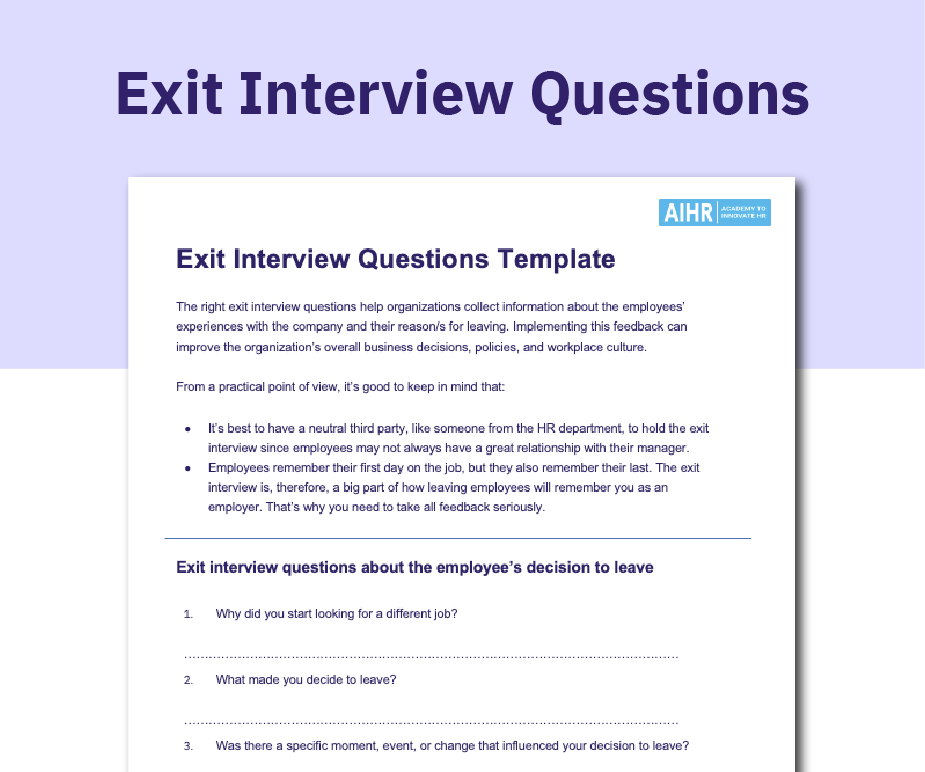
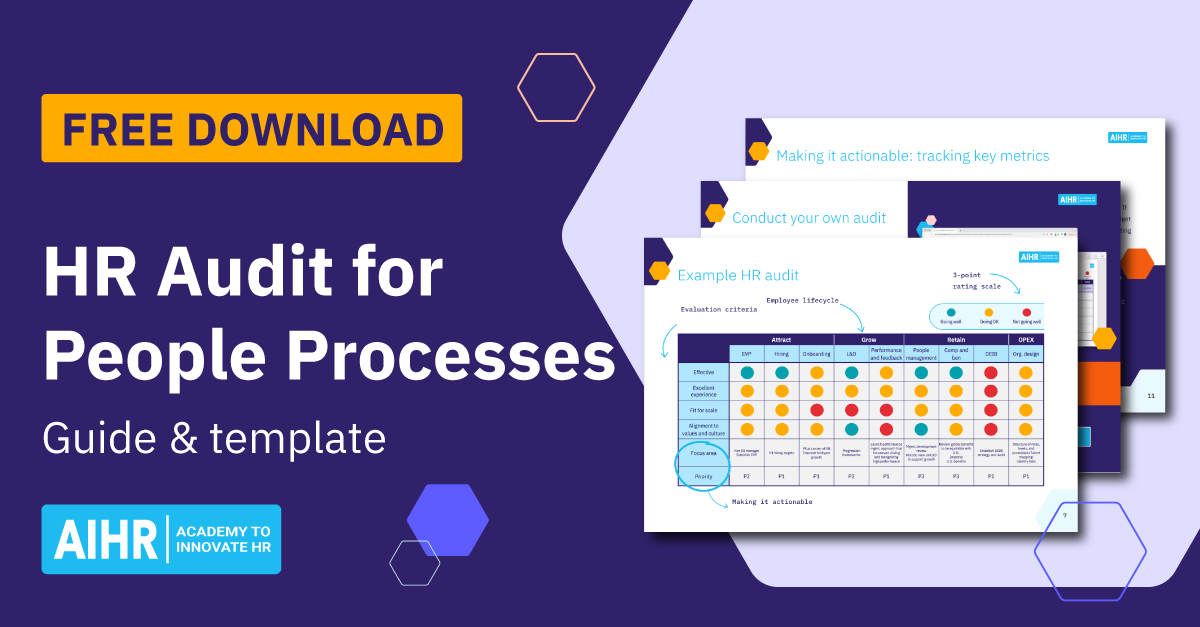
Use our free exit interview questions template to structure conversations with departing employees and document feedback consistently. The downloadable PDF includes sample exit interview questions about the employee’s reason for leaving, role, manager, team, culture, workload, growth opportunities, and overall employee experience.
How to conduct exit interviews effectively
A good exit interview gives departing employees space to be honest while helping HR collect feedback in a structured way. The goal is not to challenge the employee’s decision to leave, but to understand their experience and identify what the organization can improve.
Choose a neutral interviewer
Exit interviews are usually most effective when they’re conducted by HR or another neutral representative, not the employee’s direct manager.
This helps create a safer environment for honest feedback, especially if the employee’s relationship with their manager or team influenced their decision to leave. It also makes the conversation feel less personal and more focused on learning.
Schedule the interview close to the employee’s final working days
Timing matters. If the interview happens too early, the employee may not be ready to reflect on their full experience. If it happens on their final day, the conversation may feel rushed.
Aim for a time near the end of the notice period, when handover plans are already in motion, but the employee still has enough space to give thoughtful feedback.
Explain how the feedback will be used
Before asking any questions, set the tone. Let the employee know that the purpose of the exit interview is to understand their experience and improve the workplace for current and future employees.
It also helps to explain who will see the feedback and how it will be shared. Employees are more likely to be open when they know their comments will be handled respectfully.
Use a consistent set of exit interview questions
A consistent question set makes it easier to compare feedback across employees, teams, departments, and locations.
You can still adapt the conversation based on the employee’s role, reason for leaving, or specific experiences. The core questions give structure, while follow-up questions help you understand the context behind their answers.
Listen without defending or debating
Some feedback may be difficult to hear. The interviewer’s role is to listen, ask clarifying questions, and understand the employee’s perspective.
Avoid correcting the employee, explaining away their concerns, or turning the conversation into a debate. Even if the organization sees the situation differently, the employee’s perception is still useful feedback.
Look for patterns, not one-off comments
One exit interview can raise a concern. Several exit interviews saying the same thing can point to a pattern.
After each conversation, document the main themes and compare them with feedback from other departing employees. Look at whether certain issues are linked to specific roles, managers, teams, departments, or stages of the employee life cycle.
Turn feedback into action
Exit interviews are only useful if the organization does something with the insights.
Use recurring feedback to improve manager training, workload planning, career development, compensation practices, onboarding, culture, and the overall employee experience. Even small changes can make a difference when they address issues employees mention repeatedly.
On a final note
Good exit interview questions help HR understand why employees leave, identify recurring issues, and improve the overall employee experience. The most valuable insights come from asking relevant questions consistently, looking for patterns over time, and using that feedback to make meaningful changes across the organization.
Exit interviews are just one part of building stronger HR processes across the employee lifecycle. If you want to grow your skills in areas like employee relations, performance management, engagement, and retention, AIHR’s HR Generalist Certificate Program can help you build the practical HR knowledge needed to support both employees and the business.
FAQ
An exit interview is a structured conversation with an employee before they leave the organization. HR uses it to understand why the employee is leaving, what their experience was like, and what the company can improve for current and future employees.
The purpose of an exit interview is to understand why employees leave and identify issues that may affect retention, engagement, culture, management, workload, or career development. When HR reviews feedback across multiple interviews, it can spot patterns and improve the employee experience.
In an exit interview, HR should ask about the employee’s reason for leaving, role expectations, manager support, team dynamics, workload, compensation, growth opportunities, company culture, and suggestions for improvement. The best exit interview questions are open-ended and help employees explain their experience in their own words.



 POPULAR: 3,267 DOWNLOADS