

In brief
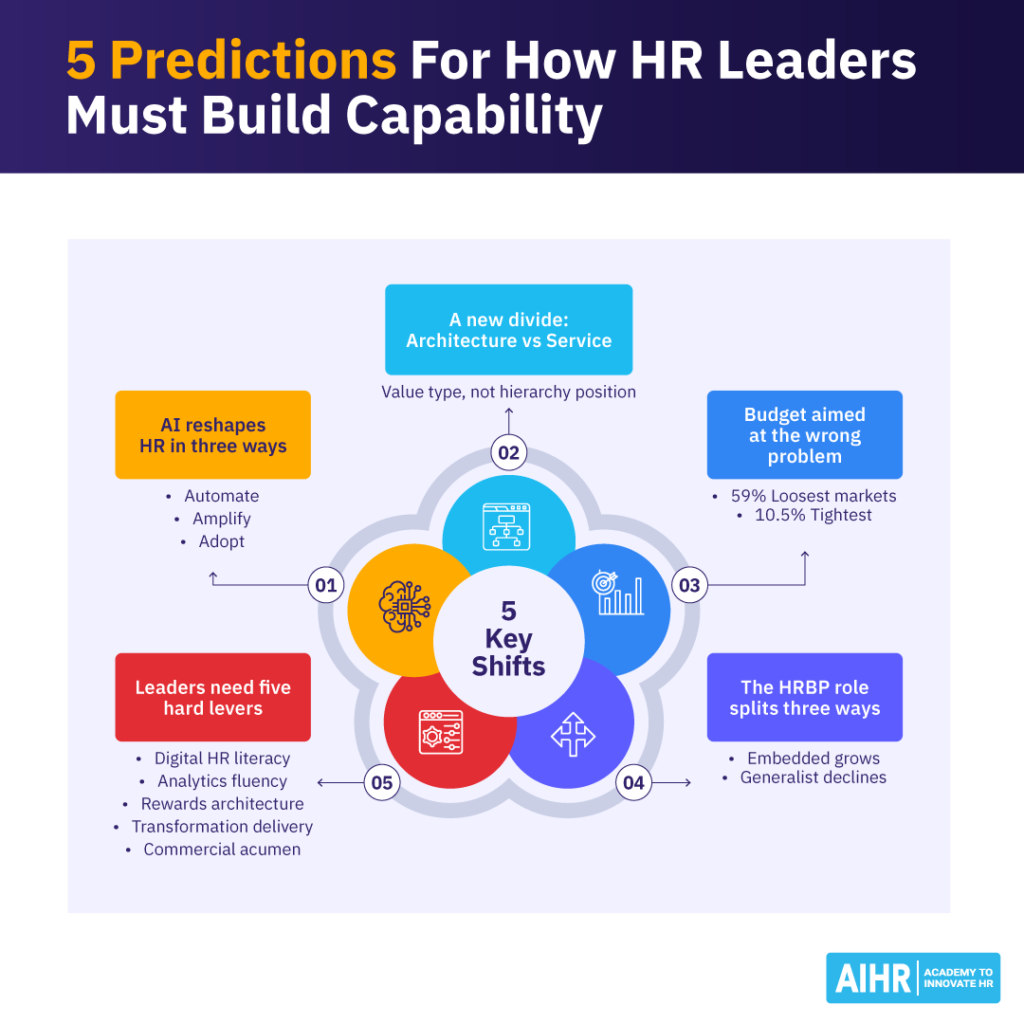
- AI is reshaping HR in three distinct ways. It is automating the service layer, amplifying analytical capability, and creating fresh demand for change adoption, and most teams are only managing the first.
- The old strategic vs. operational divide is being replaced by an Architecture vs. Service split. The work of designing systems, modeling workforces, and architecting pay is pulling away from the work of coordinating information and managing process.
- HR budgets are misaligned with market scarcity. Roughly 59% of estimated HR payroll sits in role families with more than 100 candidates per opening, while the three tightest markets (HR Technology & Digital, People Analytics, and Total Rewards) account for just 10.5%.
- The HRBP role is not disappearing; it’s splitting. Embedded, business-proximate partners with a hard specialism are growing in value, while the generalized coordination layer is being squeezed from both sides.
- Senior HR leadership now needs hard levers in addition to advisory skills. Digital HR literacy, analytics fluency, rewards architecture, transformation delivery, and commercial acumen are becoming the baseline for C-suite influence, not the differentiator.
When you look closely at what the labor market is asking of HR, the familiar efficiency story turns out to be only one of three threads. AI is automating the service layer, but it is also amplifying analytical work and creating fresh demand for change capability. That wider shift is what reshapes the operating model, the budget, the business partner role, and the job of leading the function itself.
We determined this from seven months of Revelio Labs’ US labor market data, 162,000 job postings, and 3.88 million HR professionals. The result is five predictions on capability-building, and the decisions HR leaders have an 18-month window to make.
About this research and why it matters now
As AI reshapes work, HR is not exempt from the pressure on the function. When expectations of HR shift this fast, so does the question of value: what HR does, what it is worth, and what it takes to do it well. The skills demanded of HR professionals are being redrawn, and with them the entire talent equation for the function itself. Because we wanted to understand whether HR is equipped for the challenges the labor market is now posing, we set out to run this research.
Working with Revelio Labs, we analyzed seven months of US HR labor market data across 54 defined roles, nine role families, more than 162,000 active job postings, and 3.88 million HR professionals. We looked at what is happening to demand for different HR roles, how tight or oversupplied skills are in the market, how salaries are moving, and what skills employers are actually requiring. We then asked what these patterns signal about where the profession is heading, and how HR leaders should respond.
In the sections that follow, we set out five HR capability predictions grounded in the data. For each one, we lay out the evidence, what it means for the profession, and the actions HR leaders should take today.

Prediction 1: AI is changing HR in three ways, but most teams are only managing one
The dominant narrative around AI and HR is about efficiency: AI handles the routine work, HR professionals focus on higher-value activity, and the administrative layer shrinks. This is not wrong, but it only tells one part of the story.
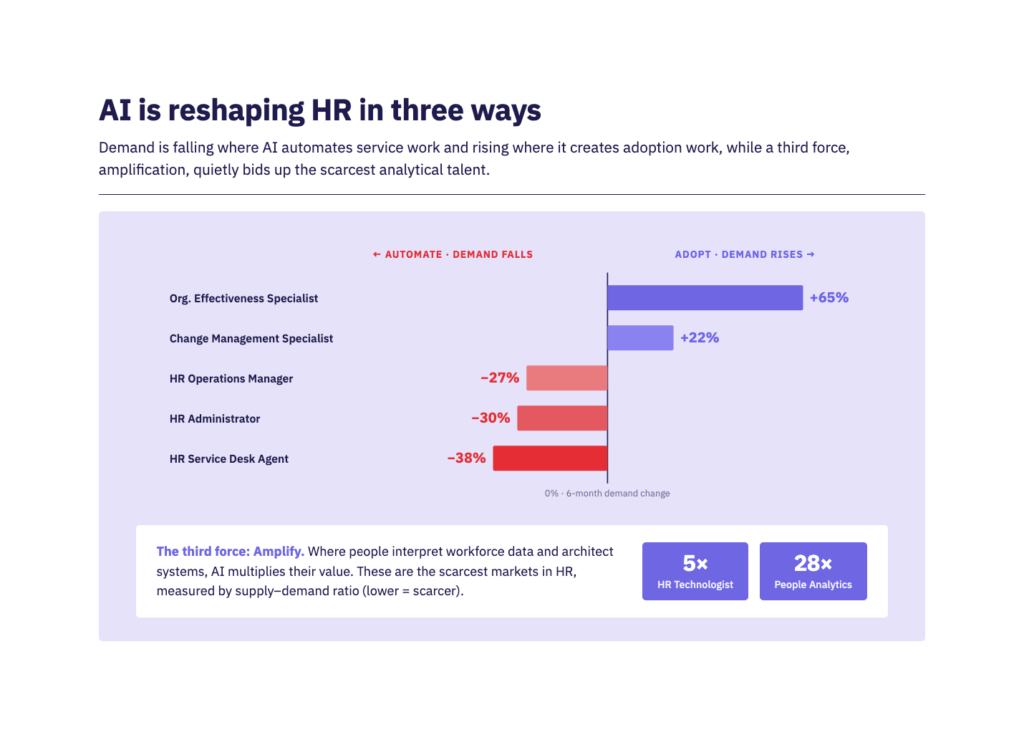
Labor market data shows three distinct ways through which AI is reshaping the HR function. Most HR teams are only noticing and preparing for the first. Few are building for the second and third, and that is where the real capability risk and opportunities for value sit.
Automating the service layer in HR
The transactional and administrative work of HR, scheduling, document handling, tier-1 employee queries, and basic reporting is being absorbed by AI-assisted tools and self-service platforms.
This is already visible in today’s hiring data. Demand for “HR Service Desk Agents” fell by 38% over six months. “HR Administrator” demand fell 30%. HR Operations Manager fell 27%. These roles are not disappearing entirely, but fewer are needed, and the roles themselves are also requiring different skills for the future.
The activity-level data within roles shows precisely why this is happening. Between 2021 and 2025, the composition of HR job postings shifted decisively away from end-to-end recruitment execution and toward higher-value, judgment-intensive work. Activities such as managing the full recruitment lifecycle and building talent pipelines declined sharply, while work tied to strategic partnership, employee relations, and compliance rose.
This is not simply fewer recruiters and more strategists. It is a redistribution of emphasis within roles toward tasks that require interpretation, context, and interaction.
Amplifying and rewarding analytical capability
Where HR professionals can interpret workforce data, design compensation systems, model talent pipelines, or architect HRIS infrastructure, AI amplifies their impact, and the market is recognizing that value. Roles such as HR Technologist carry a supply-demand ratio of just 5x. The Head of People Analytics commands a median salary of $129k, at a supply-demand ratio of 28x.
Looking at AI exposure and adoption across HR roles clarifies why this shift is so uneven. Roles such as compensation specialists, workforce analysts, and HR systems analysts sit in the high-exposure quadrant, where a large share of their work is technically automatable. But these same roles also show relatively high AI adoption, suggesting AI is augmenting rather than replacing them.
By contrast, leadership-oriented roles such as HR directors and labor relations specialists show lower exposure but comparable or higher adoption in some cases. AI is acting as a complement to analytical and systems-oriented work, while leaving judgment-heavy, relationship-driven work structurally less exposed. This is exactly the pattern you would expect if the Architecture tier is becoming more valuable, not less.
Creating demand for change adoption
Every AI implementation creates downstream work that the technology cannot do on its own, which underscores the need for specialized HR expertise in change and organizational effectiveness.
Demand for Organizational Effectiveness Specialists grew 65% in six months, to a supply-demand ratio of 36x. Change Management Specialist grew 22%. AI is generating its own demand for the very human capabilities that help organizations absorb the change it brings.
What this means for the HR profession
The capability requirements for each of these scenarios are different. The people who can redesign the service layer are not the same people who build analytical capability or drive change adoption at scale. An HR function that invests in only one of the three will free up costs in the short term, but it will find itself structurally underpowered for the work the next two years will demand.
What to do about it?
Diagnose which type of AI disruption your function is equipped to manage
- 0–3 months: Honestly assess which of the three mechanisms your HR function can manage today. Most leaders will find they are reasonable on the first, uneven on the second, and thin on the third. Name the gaps, rather than letting them stay implicit.
- 3–6 months: Stop treating AI’s impact as a single workforce planning question. Map your roles against the three scenarios. Which are being automated? Which are being amplified? Which need to grow to meet adoption demand?
- 6–24 months: Build internal capability in mechanisms two and three, because the external market for analytical, systems, and change capability is already tight and getting tighter.
The cost of doing nothing
Organizations that address only the automation story will reduce cost in the service layer while failing to build the analytical and change capability the business needs from HR. They will find themselves unable to fill the roles that unlock AI’s strategic value, not because the budget is not there, but because the capability pipeline was never built.
Prediction 2: The Strategic vs. Operational divide is being replaced by Architecture vs. Service
HR has long organized itself around a strategic/operational axis. Strategic HR, the CHROs, HRBPs, talent management, and OD shape the organization. Operational HR, the shared services, payroll, administration, and coordination, executes. While this has been a useful organizing principle, it no longer holds.
What the labor market data reveals is a different distinction, one that cuts across the traditional hierarchy and significantly influences operating model design. We call it the Architecture vs. Service split.
Architecture HR is the work of designing systems, modeling workforces, architecting pay, and managing transformation. Service HR involves coordinating information, managing processes, and providing general support. Both are necessary and have nothing to do with a role’s position in the traditional hierarchy; rather, they differentiate the type of value provided.
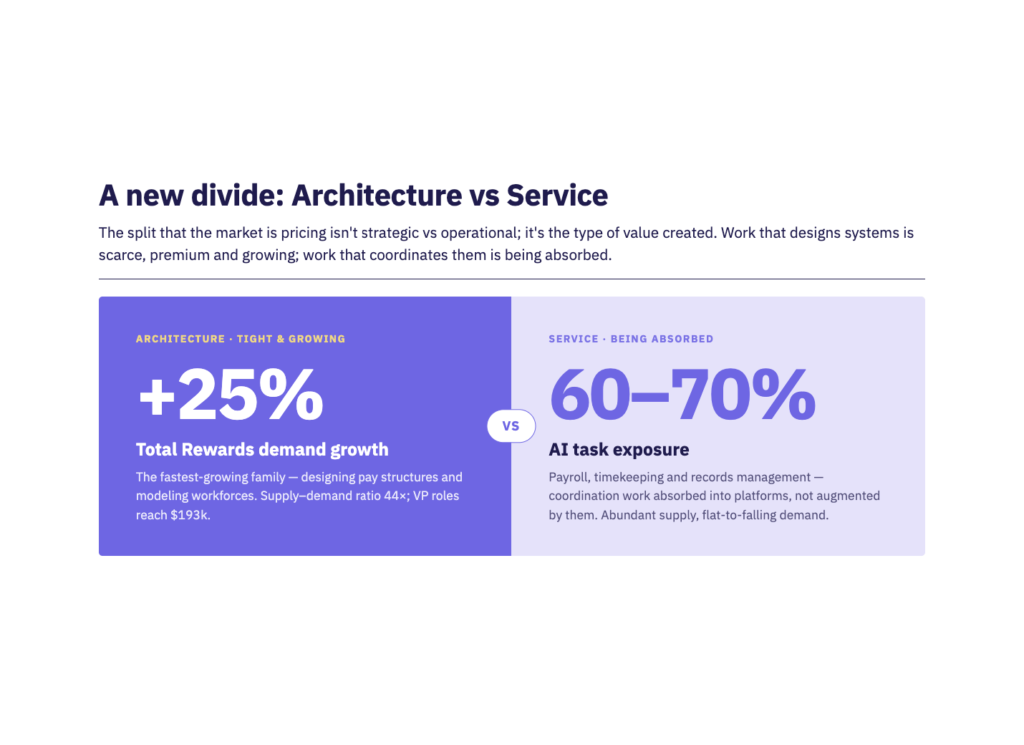
The activity-level data makes this split visible at the task level, not just the role level. Administrative and process-heavy tasks, payroll administration, timekeeping, and records management sit at very high levels of AI exposure (often above 60 to 70%) but relatively low adoption.
This should shape how HR leaders think about capability investment. The Service layer is being hollowed out not just at the role level but at the activity level, particularly in repeatable, process-driven tasks. Architecture-tier work is expanding in both demand and scope, as AI enables more sophisticated analysis, system design, and workforce planning. Capability building, therefore, needs to happen at the task and skill levels, not just at the job-title level.
The Architecture tier, HR Technology & Digital, People Analytics, and Total Rewards, sits consistently at the tight, premium end of the market. These are not temporary demand spikes, and we expect the scarcity of these domains to increase steadily over the coming months. Seven months of data already show persistent scarcity.
The three capability domains that define this tier are:
HRIS design, workflow architecture, AI implementation, digital HR strategy
HR Technologist: SDR 5xHead of Digital HR: SDR 25x
Workforce modelling, data-driven decisions, talent intelligence, pay equity analysis
Head People Analytics:SDR 28x · $129k median
Pay structure design, skills-based pay, incentive modelling, equity compliance
Total Rewards family:+25.2% demand · SDR 44x
The highest-leverage HR professionals in 2026–2028 will be those who can credibly work across all three Architecture domains. Systems fluency, analytics depth, and rewards architecture together address the full chain from organizational design to workforce insight to compensation competitiveness. This is the profile the market is competing hardest to hire and finding hardest to fill.
What this means for the HR profession
The operating model design cannot continue to use strategic/operational as its primary lens. The question for every HR role is not where it sits in the hierarchy, but rather what type of value it creates. An operating model that does not make the Architecture/Service distinction explicit will systematically underinvest in Architecture capability and overinvest in Service capacity.
What to do about it?
Map your function against the Architecture/Service framework
- 0–3 months: Classify every role in your HR function as Architecture-tier or Service-tier. Calculate what proportion of headcount and payroll sits in each. The result is usually more Service-heavy than HR leaders expect.
- 3–12 months: Identify which Architecture-tier capabilities matter most for your organization’s specific context. Prioritize two or three rather than trying to build across all domains simultaneously.
- 12–24 months: Reweight role design, hiring criteria, and development investment toward Architecture-tier capability. This is not about eliminating Service roles. It is about being intentional about where growth and investment flow.
The cost of doing nothing
An HR function that keeps redesigning its operating model around the strategic/operational axis will systematically underinvest in the capabilities the market is pricing in. The Service layer will remain well-staffed, as supply is abundant. Architecture capability will remain thin until it becomes a risk, or has to be bought at an exorbitant price tag
Prediction 3: Where HR budgets are spent does not reflect where the biggest capability challenges are
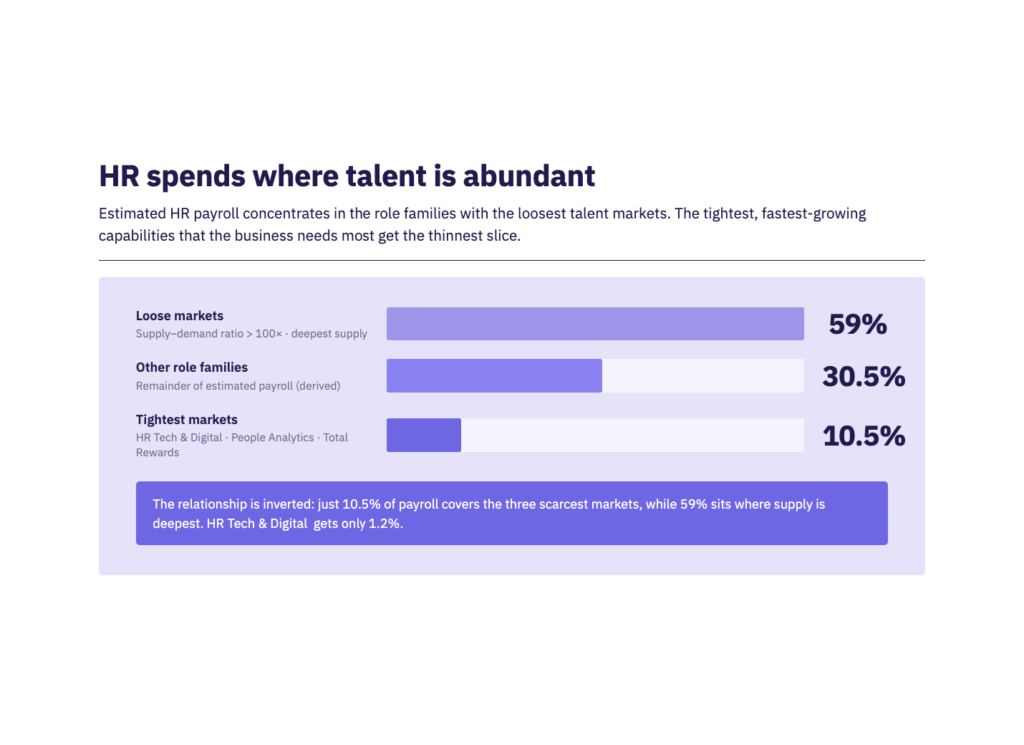
When you estimate HR payroll allocation by role family and compare it against where talent is scarce, a structural misalignment becomes visible. Roughly 59% of estimated HR payroll sits in role families with a supply-demand ratio above 100x, which means the market has more than 100 available professionals for every open role.
The three families with the tightest talent markets, HR Technology & Digital, People Analytics, and Total Rewards, represent only a combined estimated 10.5% of HR payroll.
- 59% of estimated HR payroll sits in families with an SDR above 100x: high supply, modest scarcity.
- 10.5% of estimated HR payroll sits in the three tightest talent markets in the function.
- 1.2% in HR Technology & Digital, at SDR 31x, the tightest market in the entire HR function.
- +25% Total Rewards demand, the fastest-growing family, at SDR 44x, with a $193k VP salary.
This does not mean HR operations, talent acquisition, and HRBP functions should be cut. These functions serve essential needs, but with limited HR budgets, the money will have to be distributed differently.
The current budget allocation in most HR functions was designed for an HR model that the market is actively repricing, so HR should rebalance the headcount budget in line with market realities. The investment weighting reflects historical headcount decisions more than current strategic priorities.
What this means for the HR profession
The budget conversation is going to happen, and HR needs to rebalance budgets in alignment with market scarcity. Either HR leadership leads that conversation with data and a considered proposal, or the CFO opens it as a cost-efficiency question and targets the high-profile roles the market has inflated. The organizations that come out of that conversation well are the ones where the CHRO has already done the analysis and arrives with a rebalancing thesis, rather than a defense of the status quo.
What to do about it?
Build the evidence base for the rebalancing conversation
- 0–3 months: Rebalance the HR budget. Map current HR headcount against market realities, incorporating the Architecture and Service tier framework. Calculate what sits in SDR >100x roles versus SDR <50x roles.
- 3–12 months: Develop the investment case for the two or three Architecture-tier capabilities most underweight in your function. Anchor it in concrete costs: hiring cost inflation, time-to-fill risk, and capability gaps in business-critical workstreams.
- 12–24 months: Bring the rebalancing conversation to the C-suite proactively, framed as operating model evolution. The CHRO who leads this conversation is in a fundamentally stronger position than the one who responds to it.
The cost of doing nothing
Salary inflation for Architecture-tier roles is already underway. Change Management Specialist, Compensation & Benefits Manager, HR Systems Analyst, all sit in markets where demand is growing against a constrained supply pool. The real cost of a six-month vacancy in a role with an SDR of 35x is the work that does not get done while the seat is empty, well beyond the recruitment bill itself. Waiting makes both the talent gap and the cost of closing it worse.
Prediction 4: The HRBP role is shifting, and business proximity and functional expertise are the differentiators
This is the most nuanced finding in the research, and the one most frequently misread when the data is presented at the aggregate level. The data does not say HRBP roles are disappearing. Instead, it tells three very different stories about the future of the role.
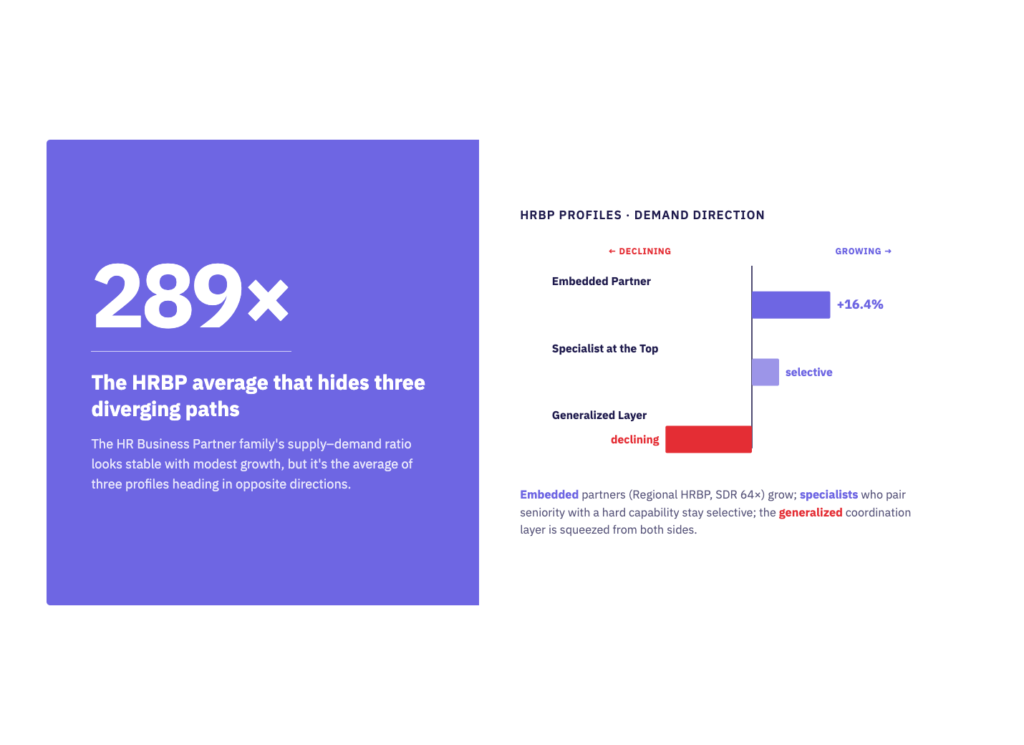
While the HRBP family as a whole shows an average supply-demand ratio of 289x with modest demand growth, that surface stability is misleading. It is the average of three structurally different profiles, each heading in a completely different direction.
The profile that is growing: The Embedded Partner
Regional HRBP has an SDR of 64x, with demand growing 16.4%. What these roles share is close proximity to the business: they sit inside the unit, carry local accountability, and own an outcome. The market is telling a clear story. Where business partnering is embedded and held to a result, it keeps and grows its value, because the work that turns on business judgment and contextual knowledge cannot be routed through a coordination layer.
The profile that is selective: The Specialist at the Top
The senior, specialist HR leadership role is becoming more selective about what it requires, rather than going away. The CHROs and senior strategic partners who command both the salary premium and the scarcity signal are those who bring specific functional capabilities: digital literacy, analytics fluency, rewards expertise, and transformation delivery. Credentials and seniority alone are no longer sufficient.
The profile that is declining: The Generalized Coordination Layer
The roles under pressure are those that primarily coordinate information, route requests, and provide generalized advice without a hard technical specialism. HRIS systems are handling more of the coordination work. Specialist HR professionals are handling more of the advisory work. The generalized middle layer is being compressed from both sides.
None of this means HRBPs are being phased out. It means the HRBP model, built around generalized seniority layers and coordination-oriented roles, is being repriced. The partner employers are competing for is the one who sits close to the business and brings a real functional capability to the table.
What this means for the HR profession
The real question for HR leaders is which HRBP profile the operating model actually needs, rather than how many HRBPs to count. The transition toward fewer, more senior, more embedded partners with specific capability specialisms is where the market is pointing. Getting there requires deliberate investment in developing those specialisms within the existing HRBP population, before resorting to a tight and expensive external market.
What to do about it?
Audit HRBP capability and capacity, not just headcount
- 0–3 months: Audit the capability profile of your current HRBP population against the five evolved leadership capabilities: digital literacy, analytics fluency, rewards architecture, transformation delivery, and commercial acumen. Be specific about where the population sits today versus what you really need.
- 3–12 months: Identify the two or three specialisms most relevant to your business context. Build structured development pathways around them within the existing HRBP population, before resorting to an expensive external market.
- 12–24 months: Redesign HRBP role descriptions to explicitly require one hard specialism. Change what you hire for and what you develop toward. This shifts the profile you attract and signals clearly which HRBP model you are building.
The cost of doing nothing
A generalized HRBP layer without clear specialisms will be progressively marginalized. It will not be eliminated, but it will be squeezed from both sides, as HRIS tools absorb the coordination work and specialist HR professionals absorb the advisory work. The organizations that address this proactively will face a far easier development challenge than those that wait until the business raises the question.
Prediction 5: HR Leadership will require more functional skills in addition to leadership capability and strategic foresight
The competency profile required for senior HR leadership is changing. The role of the CHRO and the HR leadership team is not diminishing. In most organizations, it is gaining strategic importance, as AI decisions, workforce economics, and organizational change converge in ways HR is uniquely positioned to navigate. But navigating them well requires a different competency set than the one most senior HR leaders developed on their way to the top.
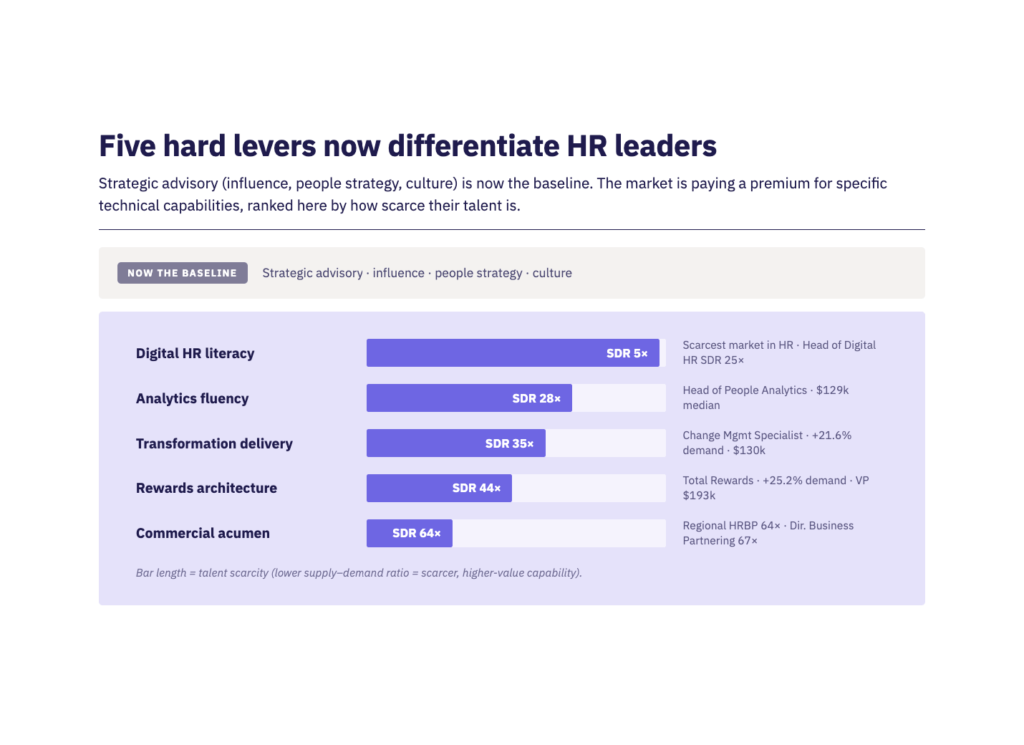
The traditional model of senior HR leadership centers on strategic advisory capability: building influence, developing people strategy, managing culture, and shaping leadership pipelines. These remain essential. What has changed is that they are now the baseline, not the differentiator. The market is increasingly pricing in specific technical capabilities that act as hard levers for HR leadership, the ones that directly alter outcomes.
Capability | What it means in practice | Why the market signals it |
Digital HR literacy | Not building systems — understanding them. The ability to interrogate an HRIS roadmap, evaluate AI vendors critically, and govern digital transformation without being dependent on others for decisions that fundamentally affect your function. | HR Technologist SDR 5x. Head of Digital HR SDR 25x. The systems layer is the bottleneck. HR leaders who can bridge strategy and architecture unblock their own function. |
Analytics fluency | Knowing what questions to ask of workforce data, what the answers mean, and how to act on them. Not building dashboards — being a credible user of the outputs and a peer to the CFO in conversations about workforce economics. | Head of People Analytics: $129k at SDR 28x. Analytics literacy is moving from a specialist skill to a leadership prerequisite. |
Rewards architecture | Understanding the economics of pay — how compensation structures work, how skills-based pay is designed, what pay equity analysis reveals, and how incentives shape behavior. This is where AI, regulation, and workforce expectations are converging most rapidly. | Total Rewards family: +25.2% demand in 6 months, avg SDR 44x, VP Total Rewards $193k. Regulatory and structural — it is not going away. |
Transformation delivery | The ability to manage the adoption side of change at scale, not just set the strategic direction. As AI implementation becomes a permanent feature of HR’s workload, the difference between organizations that adopt well and those that stall is almost always the quality of change and OD capability applied. | Change Management Specialist: SDR 35x, +21.6% demand, $130k median. Org. Eff. Specialist: +65.4% demand in 6 months. |
Commercial acumen | Understanding how the organization makes money, where its workforce costs and risks sit, and how HR decisions affect business outcomes — specifically, not in general terms. This shifts HR from a function that advises to one that drives. | The tightest HRBP markets are those closest to the business outcome. Regional HRBP: SDR 64x. Dir. Business Partnering: SDR 67x. The market rewards proximity and accountability. |
What this means for the HR profession
HR leadership development needs to be rebuilt around these capabilities. The development pathways most organizations have in place for senior HR leaders, focused on leadership presence, strategic influence, and people management, will not be sufficient to maintain authority as the C-suite’s expectations of HR evolve. Organizations that build hard-lever capability within their HR leadership team, not just in specialist roles, will have a material advantage.
What to do about it?
Assess and build toward the evolved profile
- 0–3 months: Assess the actual hard-lever capability of your senior HR leadership team across the five dimensions. Be specific. Vague development plans will not close these gaps.
- 3–12 months: Commission targeted development in the one or two hard levers most relevant to your organization’s priorities. For most teams, analytics fluency and rewards architecture are the most broadly applicable starting points.
- 12–24 months: Make hard-lever capability a requirement for senior HR leadership appointments, not just an aspiration. Rewrite job descriptions. Change what succession planning looks for. The capability shift takes time to build, which is why starting now matters.
The cost of doing nothing
The influence of senior HR leaders who rely solely on advisory capability will compress over the next two years. It will not show at first, but the CFO who can model workforce economics more precisely, and the COO who understands digital HR architecture better than the HR Director, will gradually occupy the space HR should own. The window to build these capabilities proactively is shorter than it looks from today.
The 12–18 month decision roadmap
The five predictions converge on a practical set of decisions. What follows is a sequenced roadmap of the most important decisions every HR leader needs to make for a sustainable future.
Phase 1: Diagnose | Phase 2: Prioritize & Build | Phase 3: Rebalance & Embed |
Months 0–3 | Months 3–9 | Months 9–18 |
Build an honest picture of where you currently sit. You cannot rebalance toward the right capability mix without knowing your starting point. | Make deliberate choices and begin building. Not everything at once — the two or three moves that create the most leverage for your specific context. | Make the new direction structural, not aspirational. Institutionalize the shift so it outlasts individual decisions and champions. |
Map every HR role against the Architecture/Service framework | Define 2–3 Architecture capabilities critical to your operating model | Bring budget rebalancing proposal to C-suite, framed as evolution, not cuts |
Audit HRBP capability profile against the 5 evolved dimensions | Begin structured internal capability pathways for hardest-to-fill roles | Embed change management as a structural competency — not a project resource |
Calculate HR budget allocation by tier. What sits in SDR >100x roles? | Reframe L&D mandate to include Org. Effectiveness as a core function | Redesign HRBP and senior HR role descriptions to require a hard specialism |
Identify 3 hardest-to-hire roles and assess internal capability adjacency | Build the budget rebalancing case with concrete cost data | Begin succession planning for the evolved senior HR profile. Build the pipeline now |
What the HR function faces is a strategic repositioning rather than a crisis. The Architecture-tier capabilities are scarce and growing while investment in them lags, the HRBP model is starting to differentiate by capability rather than seniority, and the leadership profile that commands C-suite influence is shifting toward hard levers. For most HR functions, the budget allocation and the workforce plan reflect none of this yet.
All of these can be solved, but together they make for a burning platform. The organizations that come through this well will be the ones whose HR leaders take a clear-eyed, portfolio view of the function, are honest about where the value is concentrating, and rebalance toward it before the market forces the question.
We work alongside HR leaders every day who are making exactly these decisions. The data in this research, produced through our analysis with Revelio Labs, is our contribution to those conversations and part of an ongoing commitment to the sustainable future of a profession we believe is crucial to ushering in a new era of work.
HR has everything it needs to lead through this moment: the proximity to the business, the understanding of people, and now the data. The question is whether the function makes the strategic decisions that position it to do so.